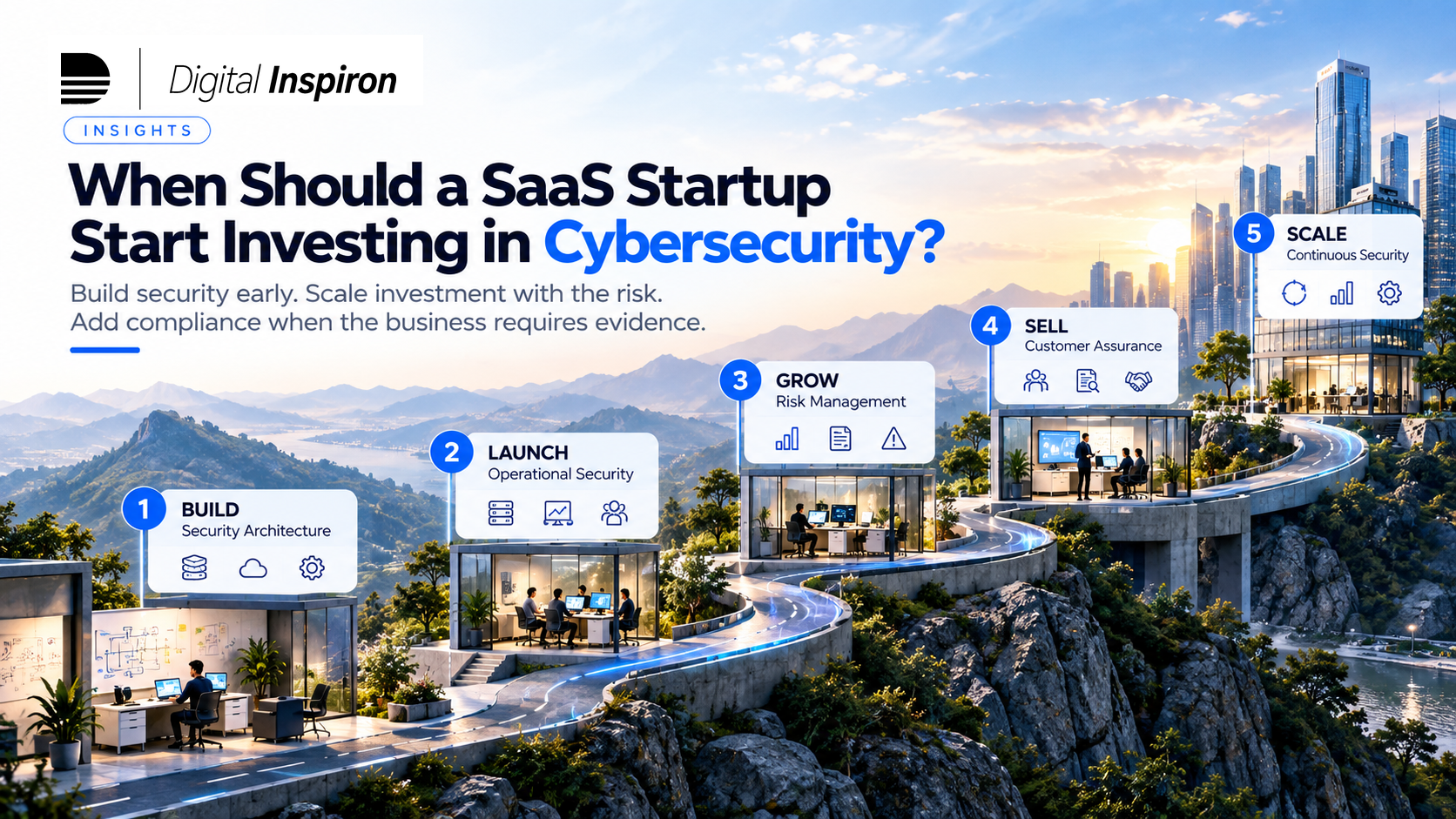
Security is not an all-or-nothing investment
When should a SaaS startup start investing in cybersecurity?
For many founders, the question appears to come with two very different answers.
One is to treat cybersecurity as something for later, after the product has customers, revenue or enterprise demand.
The other is to approach a young startup as though it already needs the security organization, tooling and processes of a mature enterprise.
Neither is a particularly useful way to think about the problem.
A two-person startup building its first product does not need the same cybersecurity program as a SaaS company serving thousands of customers.
But that does not mean security can simply be postponed.
Some security decisions become part of the product's architecture. Authentication, authorization, customer-data isolation, secrets management, infrastructure access and production boundaries are much easier to design correctly than to repair after a product has grown around weak assumptions.
The better question therefore isn't:
When should we start doing security?
It is:
What level of security investment is appropriate for the risk we have today?
Our answer is straightforward:
Start security early. Scale the investment with the risk.
“Security should start with the architecture and grow with the risk.”
Cybersecurity investment does not mean building a security department
The word investment can make cybersecurity sound expensive.
A founder may immediately think about dedicated security engineers, penetration tests, enterprise security platforms, a Security Operations Center, certifications and lengthy compliance programs.
Those can become relevant as a company grows.
But they are not where cybersecurity investment has to begin.
For an early SaaS startup, investment may simply mean engineering the product with safer defaults.
It may mean protecting production credentials properly instead of keeping secrets in source code.
It may mean designing authorization deliberately instead of checking only whether a user is logged in.
It may mean separating development and production environments, restricting privileged access, reviewing dependencies, maintaining useful logs and ensuring backups can actually be recovered.
Some of these measures cost more engineering attention than money.
That matters because an early startup's most important security decisions are often architectural decisions.
Security does not have to begin with a security department.
It can begin with how the software is built.
A stage-based approach
SaaS cybersecurity Build
Security maturity should grow with exposure, customers and business risk—not with an arbitrary company age.
-
Launch
Protect production systems before real customers depend on them.
-
Grow
Increase security investment as data, users, integrations and infrastructure expand.
-
Sell
Prepare to demonstrate security when larger customers and procurement teams require evidence.
-
Scale
Turn security into a continuous organizational capability.
Stage 1
While you're building the SaaS product
The earliest stage is where security is easiest to underestimate—and where architectural assumptions are created.
There may be no customers yet. There may be little sensitive data. The team may consist almost entirely of founders and engineers.
But this is also when architectural assumptions are being created.
Consider a multi-tenant SaaS application.
- How does the system determine which customer can access which records?
- Where are API credentials stored?
- Who can access production infrastructure?
- How are privileged actions authorized?
- How are customer accounts isolated?
- How are authentication tokens handled?
These are not primarily compliance questions.
They are product architecture questions.
An early-stage startup does not need every security control it may eventually require. But it should avoid creating foundations that make basic security dependent on future rewrites.
The goal at this stage is not to prove that the startup has a mature cybersecurity program.
The goal is to make security part of the engineering decisions that are already being made.
Security foundations worth considering early
-
Identity & Access
Design authentication and authorization around who should be able to access each resource and action.
-
Tenant Isolation
For multi-tenant SaaS, make customer boundaries an architectural concern rather than relying on UI behavior.
-
Secrets Management
Keep credentials, tokens and production secrets outside source code and control access to them.
-
Secure Infrastructure
Reduce unnecessary exposure and restrict administrative access to cloud and production resources.
-
Dependency Management
Know what your application depends on and create a process for identifying and addressing vulnerable dependencies.
-
Data Protection
Understand what customer data you collect, where it is stored and how access to it is controlled.
Stage 2
Before real customers depend on the product
Moving into production changes the security question from engineering defaults to operational readiness.
The system is no longer only an engineering environment.
Real accounts exist. Real customer data may enter the platform. Production availability matters. Credentials become valuable. Mistakes can affect people outside the development team.
Security therefore starts becoming operational.
A startup should know who has production access and why.
Backups should exist where appropriate, but the more important question is whether the startup could actually recover from them.
Logs should provide enough information to investigate important events.
Production and development should have appropriate boundaries.
Deployment paths should be controlled.
Critical vulnerabilities need a way to be identified, prioritized and addressed.
And the team should have at least a basic answer to:
What would we do if we believed our production environment or customer data had been compromised?
This still does not require enterprise-scale security operations.
It requires recognizing that once customers depend on the product, security failures become business failures as well as technical ones.
“A startup does not need enterprise-scale security on day one. It does need security decisions that will survive growth.”
Stage 3
As customers, data and integrations grow
Growth changes the risk profile. Security investment should become progressively more systematic.
More customers can mean more data.
More employees can mean more accounts and permissions.
More integrations can mean more credentials, APIs and third-party dependencies.
More infrastructure can mean more configurations that need to be understood and maintained.
And a larger product surface creates more places where mistakes can happen.
This is when security investment should become progressively more systematic.
Access reviews may need to become formalized. Vulnerability management may need clearer ownership. Monitoring may need to improve. Security testing may need to become more frequent. Incident response needs to become more than an informal conversation between founders.
The important point is that cybersecurity investment should not scale simply because the startup reached a particular age.
It should scale because the company's exposure, consequences and responsibilities have changed.
Stage 4
When security becomes part of the sales process
For many B2B SaaS startups, larger organizations bring procurement questions—and security becomes commercial readiness.
The product may work.
The prospect may want it.
Then procurement begins asking questions.
- How do you protect customer data?
- Who can access production?
- How do you manage vulnerabilities?
- What happens during a security incident?
- How do you manage third-party providers?
- Can you demonstrate that security controls actually exist?
At this point, security is no longer only a technical risk.
It can become part of the company's ability to sell.
This is also where founders need to distinguish security from compliance.
They are related, but they are not the same thing.
Security and compliance are different questions
A startup may need good security engineering long before it needs a formal certification or audit.
-
Security asks:
How do we reduce risk and protect our systems, customers and data?
-
Compliance asks:
What requirements apply, and how can we demonstrate that the required controls exist and operate as expected?
-
Customer assurance asks:
What evidence will customers need before trusting us with their systems or data?
-
The timing can differ.
Security capability often needs to precede formal compliance evidence.
Do not wait for compliance to start security
One of the mistakes SaaS startups can make is treating a future compliance project as the point when cybersecurity begins.
Security should precede that.
If a startup eventually pursues a framework or attestation because customers, contracts, regulation or business strategy require it, the process is much easier when secure engineering and operational practices already exist.
Otherwise, compliance can become an expensive exercise in retrofitting controls into a system and organization that were never designed around them.
There is also an opposite mistake.
A startup can spend heavily on formal compliance before its market, customers or risk profile justify that investment.
The objective should not be to collect security badges as early as possible.
The objective should be to develop security maturity at a pace appropriate to the business.
Build the security capability first. Add formal evidence when the business requires it.
DevSecOps
Why DevSecOps matters before you have a security team
A young SaaS company may not have a dedicated security engineer. It does have a software development process.
That makes engineering one of the most practical places to introduce security early.
This is where DevSecOps for startups becomes useful.
DevSecOps should not mean buying a collection of security tools and adding them to CI/CD.
The underlying principle is more valuable:
Security becomes part of how software moves from an idea to production.
- Code is reviewed.
- Dependencies can be checked.
- Secrets are kept out of repositories.
- Deployment permissions are controlled.
- Infrastructure changes are reviewed.
- Security checks can be automated where they provide useful signal.
- Production access is limited.
- Important operational events are logged.
- Vulnerabilities have an owner rather than sitting indefinitely in a report.
The exact implementation should match the startup's technology, risk and resources.
The goal is to make secure engineering increasingly repeatable without making development unnecessarily bureaucratic.
A practical DevSecOps foundation
-
Code
Review changes with security-relevant judgment, not only feature completeness.
-
Dependencies
Know and review the third-party packages you ship.
-
Secrets
Keep credentials out of repositories and chat history.
-
CI/CD
Control who can deploy and what automated checks run on the way.
-
Cloud
Review infrastructure changes with the same care as application code.
-
Production
Limit access, log important events and own vulnerability remediation.
Signs your SaaS startup may be underinvesting in security
There is no universal funding round or employee count that tells a startup exactly how much cybersecurity it needs.
There are, however, warning signs.
If everyone has broad production access because it is convenient, the risk has changed.
If customer isolation depends on developers remembering to apply the right filter everywhere, the architecture deserves attention.
If production secrets are scattered across repositories, messages and personal machines, the startup has a secrets-management problem.
If nobody knows whether backups can be restored, having backups may provide false confidence.
If critical vulnerabilities are discovered but nobody owns remediation, scanning alone is not a security program.
If enterprise prospects repeatedly ask security questions the company cannot answer, security has started affecting commercial readiness.
And if an incident would leave the team unsure who should investigate, communicate, contain and recover, operational maturity needs to catch up.
These signals are more useful than waiting for an arbitrary milestone such as “Series A” before deciding security matters.
But startups can also overengineer security
Underinvestment is not the only mistake.
Startups operate with limited capital, engineering capacity and time.
Every security measure has an implementation and operational cost.
A pre-revenue team does not necessarily need the same tooling, processes, reporting structure or governance model as a mature enterprise SaaS company.
Adding controls without understanding the risk they address can slow development without producing proportional security value.
Buying sophisticated tools that nobody has time to operate can create dashboards rather than security.
Pursuing certifications that no customer, regulator or business objective currently requires can consume resources better spent elsewhere.
The goal is not maximum security spending.
It is appropriate security for the company's current exposure and trajectory.
That requires prioritization.
Protect the things that would matter most if they failed.
Strengthen the foundations that become expensive to replace later.
Then increase security capability as the product and business become more valuable, interconnected and exposed.
A practical SaaS security baseline
This intentionally stays a baseline—deep enough to act on, without turning into an enterprise program prematurely.
-
Know your assets
Understand the systems, infrastructure and data the business depends on.
-
Control access
Use appropriate authentication, authorization and least-privilege practices.
-
Protect secrets and data
Treat credentials and customer information as security-sensitive assets.
-
Secure the delivery process
Introduce security into development, dependencies, CI/CD and infrastructure changes.
-
Prepare for failure
Maintain appropriate backups, recovery procedures, logging and basic incident readiness.
-
Keep improving
Reassess security as customers, data, integrations, employees and business requirements change. This intentionally stays a baseline. We can build a separate SaaS Security Checklist Insight with much deeper implementation coverage and link to it later.
Invest according to risk, not company size
So when should a SaaS startup start investing in cybersecurity?
From the beginning, but not at the same level it will invest later.
Early investment should focus on architecture and secure engineering.
Before production, operational fundamentals become important.
As customers, data, integrations and infrastructure grow, security practices should become more systematic.
When larger customers begin asking for evidence, security becomes part of commercial readiness.
And as the company scales, cybersecurity becomes an ongoing organizational capability rather than a collection of individual engineering decisions.
There is no single moment when a startup suddenly becomes large enough to “need security.”
Risk grows gradually.
Security maturity should grow with it.
The goal is not to build an enterprise security organization before the business needs one.
And it is not to wait until a customer, auditor or incident exposes what should have been addressed earlier.
The more useful principle is:
Build security early. Scale investment deliberately. Add compliance when the business requires evidence.
“Build security early. Scale investment deliberately. Add compliance when the business requires evidence.”